



Case Studies
 |
 |
 |
| Client: |
|
One of Canada's largest niche market providers of travel and health insurance products. The Company, through its subsidiary, also provides assistance, case management, cost containment and claims services. The Company in exploring new avenues for growth has identified claims repricing domain as a future growth driver. |
The Problem: |
|
Claims repricing (Claim repricing is the application of a fee schedule to a medical claim and is driven by the payor or healthcare plan administrator's need to access a healthcare network's contracted discount rates), in a manual scenario, would encompass faxing or mailing in a paper claim for repricing, manual entry into a claims processing system - the whole process thereby involving several layers of personnel leading to a spiraling operational cost and longer process times. The Company requested Inteq to provide a solution to reprice claims electronically with minimum human intervention. |
Inteq's Approach: |
|
Since the requirements were not well established, Inteq proposed a two phased approach. The goal of the first phase was requirements gathering, analysis and high level design of the proposed system. Inteq business and technical analysts helped develop the requirement specifications and design of the proposed system christened 'e-Repricing'. On completion of first phase a fixed price estimate was provided along with a detailed schedule. The second phase involved project execution. To help implement the phases, Inteq adopted its established on-shore/offshore delivery model. The on-shore work included first phase, acceptance testing, implementation and support activities. |
Solution Offered: |
|
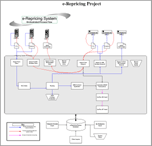
The requirements as recommended at the end of first phase included a system to assist the Company to reprice claims using its own automated or manual provider contracts and also provide option to electronically exchange claims with other contracted networks that are capable of repricing claims. The system is to have inbuilt capabilities to route claims to an appropriate network and receive repriced information with minimal user interaction. Inteq in discussion with the Company recommended the approach of having two IT building blocks which include an EAI platform and a web application. The web application, clients and networks are to be seamlessly integrated, utilizing an EAI platform. |
 |
|
Gentran Integration Suite (GIS) was used as the EAI platform to receive, format and track claims. This platform orchestrates and launches the various programs in the web application in order to perform the required business rules. The web application implements the core business rules related to repricing and was built on a Microsoft development platform. The application exposes some of the core business rules as web services and provides user interfaces to ACCPAC accounting system and Cognos Document Management tool. |
| Benefits: |
|
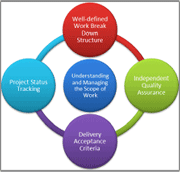
e-Repricing system will facilitate the Company to electronically exchange claims information with clients, improve productivity in terms of claims management, bring new business and optimize cost Inteq maintained and tracked the deliveries from a cost, schedule, risk and quality perspective. The key success factors were: well defined requirements, well defined worke-breakdown structure, project status tracking, independent quality assurance, and acceptance criteria tied to each deliverable. Inteq helped the Company save over 40% in total project costs using a blended offshore/ on-shore model. The Company has decided to use this blended delivery model for other projects and has engaged Inteq as their offshore delivery partner in designing, developing and maintaining their IT systems. |
| The Client: |
|
The Company develops and deploys sophisticated, high performance software applications, primarily for the healthcare industry. Their two flagship products LabWorks and WebvCMR are designed for laboratories and public health departments to maintain lab orders and track outbreaks. |
| The Problem: |
|
Lab Works, WebvCMR and NCM require regular enhancements and upgrades to meet client requirements, HL7 and HIPAA compliance. Quality of the product releases became the major concern for the Company. To mitigate quality risks and streamline quality product delivery to its clients the Company wanted implementation of a proven and stable process for handling software testing of product releases across various clients. The Company requested Inteq to assist in conducting an independent review of their quality system and procedures for product releases. |
| Inteq's Approach: |
|
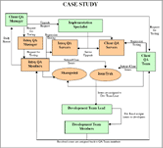
Inteq quality assurance team conducted review of the quality system and procedures in the year 2001. The study included all areas related to software testing and product release procedures. The study recommended refinements to the quality process which included: |
|
|
|
Inteq adopted its established on-shore/offshore delivery model, wherein the approach was to evolve the quality assurance processes over several product releases with the help of the offshore team. Inteq has over the last few years assisted the Company in implementing the quality process and systems without affecting the organization culture. This has helped in improved efficiency, reduced cycle times, increased customer satisfaction levels and reduced costs through off-shore work. The Company has decided to use this blended delivery model for other projects and has engaged Inteq as their offshore delivery partner for software testing and quality initiatives. Inteq currently has a large team of quality consultants involved in end to end software testing of all products of the Company. |
 |